Since the Russian invasion of Ukraine, the waters in the Black Sea have not
calmed down.
From the first days of the occupation, although the demand of Western
states, especially the USA, to send a navy in the Black Sea by suspending the
terms of the Montreux Agreement, put Turkey under great pressure, Turkey has
not made any concessions from the Montreux Agreement until now.
Desiring to see the Black Sea as a sea of peace, Turkey established the
Black Sea Economic Cooperation organization and included even Armenia in this
organization, seeing the Black Sea not only as a sea where borders are shared,
but also as a common denominator where problems are resolved.
Among the difficulties faced by Turkey in its geography, although the
developments in the Aegean and the Eastern Mediterranean have increased the
possibility of conflict that has become more apparent in recent years, despite
the Ukrainian occupation, a risk that engulfs Turkey in the Black Sea has not
emerged yet.
Although Russia's idea of locking the Straits lies behind the uncontrolled
flow of sea mines off the Ukrainian coast, the absence of an exploding bomb is
a result of Turkey's keeping the necessary navy ready by following the process
closely.
The fact that Russia is still the dominant power is still evident, even
though the Ukraine invasion is subject to Ukrainian attacks that will take
these steps back by Russia, which has advanced by cutting off its sea
connection.
Excluding this and making a Ukraine-based Black Sea analysis may mean
breaking with reality.
Since Turkey knows Russia's power and influence from the very first day, it
maintains its position of not accepting border changes in the future against
border disputes involving Turkey, while maintaining good relations with Russia
despite Russia's aggression.
Moreover, the fact that Russia, which sees NATO as the reason for attacking
Ukraine, is willing to act as a mediator without even mentioning that Turkey is
a NATO member, shows the confidence shown.
This situation is actually a result of the joint security mechanism between
Turkey and Russia that was created in Syria and continues in Azerbaijan.
Experienced processes have proven that new approaches, which are
established by clearing the past fears and doubts, are also facilitating in the
solution of other problems.
What Turkey wanted to provide in the Black Sea was the correct application
of these previously established ties in the business.
In fact, it should not be overlooked that behind this, another process that
started after the downing of the Russian plane that violated the Turkish
airspace from the Syrian border is an accelerator.
After the downed plane, Russia's ban on tourists and the suspension of
tomato imports from Turkey hurt Russia the most.
After this loss, Russia, which is in search of normalization in relations
without compromising its reputation, came to the rescue of the President of the
Republic of Turkey, Recep Tayyip Erdoğan, with an apology letter.
The rapidly developing normalization process after the two countries made
them see that they were the only losers.
A similar process has been taking place between Europe and Russia since the
invasion of Ukraine. Although Russia, which was even excluded from the Council
of Europe, was seen as a part of Europe until yesterday, the only reason why it
is today's persona non grata is of course not the occupation of Ukraine.
The uneasiness created by Russia is the same as Hitler's Germany...
Europeans are living in Ukraine with the fear of German invasion, which
cannot be lessened even by the involvement of British Prime Minister Neville
Champerlain, who gave the green light to Hitler's invasion of Czechoslovakia,
in the fate of another nation.
The Europeans, who do not believe that a piece of land to be given from
Ukraine will stop Russia, are in great loyalty to the Ukrainians, with whom
they are not very related.
But this loyalty brings with it another process where today Europe will
suffer much more than a military invasion.
In recent years, we have watched European leaders, who say that NATO is
brain dead, continue to divert this resource to other areas instead of fulfilling
the NATO requirement to spend 2 percent of the budget for defense expenditures
for years.
With the occupation of Ukraine, a sharp turn began to take place in this
regard.
It was stated that the military power will be increased with the spending
of 100 billion euros announced by the new Chancellor of Germany, Scholz.
In Japan, the first steps were taken to return from a pacifist
constitution.
After the assassination of Shinzo Abe, who argued that the constitution
should be changed and Japan should establish an army with improved intervention
capability, the goal of Abe's Liberal Party, which took power in Japan, was to
enlarge the army.
Behind this decision, there is definitely the issue of the Kuril Islands,
which is an area of conflict between Japan and Russia, as well as the
developing aggression of Russia against Ukraine.
It is seen that Turkey, which can only sit at the table with both sides,
has a very unique place among the NATO countries, which are trying to distract
Russia's aggression with more economic power instead of a chance to
counterattack.
As the President of the Republic of Turkey Erdogan stated in the 77th
General Assembly speech of the United Nations, Turkey wants to continue its
mediation between Russia and Ukraine.
Although the expectation for a ceasefire after the Istanbul talks went back
depending on the developments in the field, the establishment of the Grain
Corridor shows that Turkey's influence on the two states still continues.
The fact that Russia, which declared mobilization with the autumn months
when Ukraine started a counter-attack, continued this step with Putin's threat
of nuclear attack, showed that Russia's economic stagnation, as well as its
tolerance for loss on the field, were up to a point.
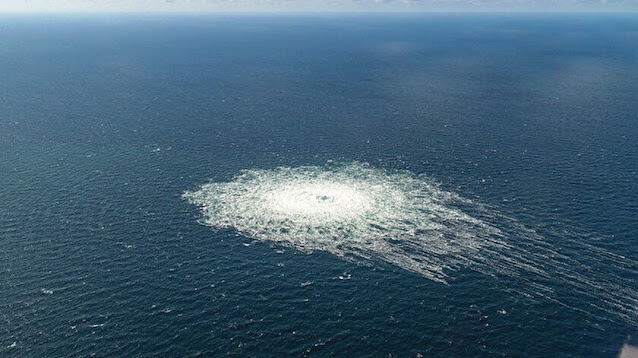
This step of Russia, which cut off the natural gas flow indefinitely at the
end of the summer, did not yield any results and the Europeans' emphasis on
savings instead of taking a step back caused Russia to put forward a strategy
that increased the military tone.
This situation, which Europe carries out without attacking Russia, may
start a new process.
In particular, the fact that Finland and Sweden are waiting for approval in
the parliaments of the last five NATO states regarding their NATO membership
contains another threat.
Although it is an assurance for Russia that Turkey has a say in the
admission of these two states, which Putin warned about joining NATO, another
threat exists as Europe maintains its sharp language against Russia.
Although it is not easy for Russia or Europe to reach this threat, the
implementation of a referendum in the regions occupied by Russia and adding
these regions to its borders can be seen as an effort to provide international
justification for the nuclear attack.
The fact that the President of Ukraine, Zelensky, is gradually moving away
from the ceasefire with his success in regaining the lost lands, exists as a
great threat in the Black Sea's departure from the atmosphere of the sea of
peace.
The Black Sea, through which natural gas pipelines pass and is also a trade
route for the Belt and Road Initiative, will also become a natural gas
production region by 2023, making it a more strategic and conflict-free region
for Turkey.
Although it does not seem possible to find a solution for the European states
to survive the expected hard winter, the process may soften if the expectation
that Russia adopts a gradual normalization policy and that the pacifist
reaction of the Europeans in the same Crimea will continue against the new
referendum regions.
The increased risk of conflict will cause Russia to want to show its
aggression even more harshly.
Even though there is enough US dollars in the Russian Central Bank until
2025, Russia's option to establish a new export route through Turkey, which is
isolated from international trade, strengthens the belief that the peace
climate in the Black Sea will not deteriorate.
The general conclusion drawn from this whole equation was the fact that
Europe's commitment to the green deal fell off the agenda and ignored all
carbon problems to keep warm.
While it is clear that the green transformation targets planned for 2030
should be revised at a later date, the possibility of making Turkey the new
production base for the Europeans gives a slight chance of realizing the green
agreement targets.
While Turkey and European leaders' maneuvers in domestic and foreign policy
will determine where the process will evolve, Turkey 's intimidation of the EU
for membership in the Shanghai Cooperation Organization shows that Turkey is aware
of the balances and will not give up its trump card that easily.
In this intertwined process, the US's approach beyond selling LNG to Europe
may cause it to assume a game-changing role, and the possibility that the
unchanging stance will allow China to enter the playing field should not escape
the attention.
With the investment plans of China, which is already energy-hungry, making
Russia respond to its own demands, it reveals new economic routes that other
states in Central Asia, including Mongolia, have gained.
There is a situation in which the world may embark on a transformation away
from the USA's control with reserve money initiatives, but the USA's reaction
to this cannot be predicted.
In all these balances, it would be an expression of truth to say that
Turkey and the Black Sea will have a say and this will have a changing weight
in the system.
This article was published in TESPAM's Black Sea Report titled Energy Crisis.
Click here to access the report.